



















Bridges are a part of everyday life, carrying cars, trains, and pedestrians across otherwise impassable spaces. Beyond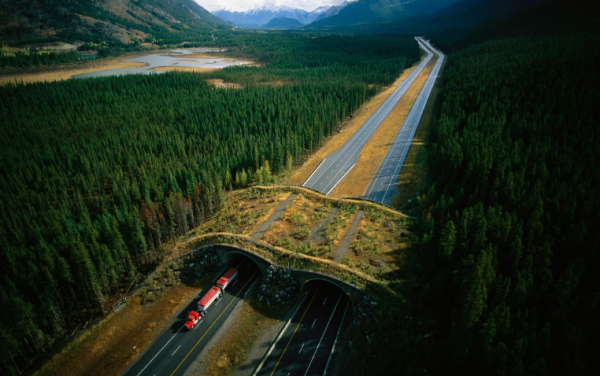 their importance to humans, bridges can also serve wildlife. In the United States alone, more than two million large animals are killed each year in vehicle collisions (“Bridging the Gap”). These alarming numbers highlight the need for safer alternatives, leading to the development of ecoducts, which are specialized green overpasses designed to allow animals to cross roads safely. Although the U.S. has built several wildlife crossings, many are standard, narrower overpasses. In contrast, European countries more frequently construct wider, more environmentally integrated crossings that better support diverse species.
Why the United States Lags in Wildlife Crossing Design
The United States often appears “behind” countries like the Netherlands when it comes to wildlife crossings. Historically, U.S. projects have focused on protecting specific species, such as deer or elk, which has led to the construction of narrower, more targeted overpasses (Kuta). In contrast, many European countries design wider, ecosystem-scale crossings that support a greater variety of wildlife and vegetation.
However, this gap is beginning to close. Recent federal funding programs have increased support for wildlife crossings across the country, and at least 19 states are now building new projects (Network). While the U.S. does have ecoduct-style bridges commonly referred to as wildlife overpasses, most existing structures are still smaller than those in Europe. Even so, newer designs are becoming larger and more environmentally integrated, showing clear progress toward matching European standards.
How Effective are Wildlife crossings?
Wildlife crossings have proven to be highly effective in reducing vehicle collisions and supporting healthy ecosystems. Studies show that wildlife overpasses and underpasses can reduce animal–vehicle collisions by up to 80–90% when combined with proper fencing (Blackledge). A well-known example is Banff National Park, where a network of wildlife crossings has allowed animals such as bears, elk, and wolves to safely cross highways more than 200,000 times (Parks Canada).
These crossings not only prevent accidents but also help maintain migration routes and genetic diversity by reconnecting habitats that roads have divided (Wildlife migration). As a result, experts argue that investing in larger, ecosystem-based crossings similar to those commonly built in Europe could significantly improve road safety for both humans and animals.
In conclusion, wildlife crossings play a crucial role in making roads safer for both animals and humans. While the United States has made progress by building wildlife overpasses, it still lags behind countries in Europe that focus on larger, ecosystem-based designs. However, with increasing awareness and new funding, the U.S. is beginning to improve and expand these structures. We are on the right path to creating balance between human development and the natural world.
Citations:
Washington Public Lands Inventory. (n.d.). Washington State Legislature, July 2014, from lawfilesext.leg.wa.gov/biennium/2015-16/Htm/Bill Reports/House/1192 HBA CB 15.htm.
National Park Service (U.S. national park service). (n.d.). Retrieved February 24, 2026, from https://www.nps.gov/state/wa/index.htm