





What could possibly be the connection between a single hog’s death, a prosperous British sheep farm, and comically unclear communication?
The Pig War is perhaps the only answer. It is one of the most unique wars the US has ever participated in, and to this day claims the title of, “The Only War Where The Only Casualty Was A Pig!”
The background of this war includes much discussion over boundary lines and British-versus-American borders in what is now Washington State.
Quickly summarized, the Treaty of Oregon was signed in 1846 by President James Polk. This treaty outlined the partitions from the Rocky Mountains to “the middle of the channel which separates the continent from Vancouver’s island.”
And it turns out there are actually two channels; the Haro Strait and the Rosario Strait, which both lay around the island.
Oops.
Background Knowledge
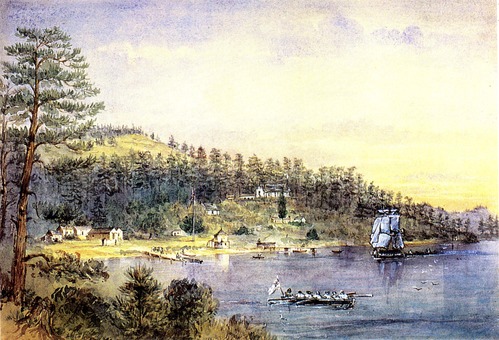
The British Hudson’s Bay Company had claimed San Juan Island since 1845. They actually owned a very prosperous Belle Vue Sheep Farm. (Sound familiar?)
Many British homesteads and companies resided on the island. It was known for having amazing, rich soil; a worthy prize for farmers everywhere.
After the Treaty of Oregon was signed, American farmers flocked to the island as well. By 1859, almost twenty American families had staked their claims. . .
. . .much to Britain’s distress. They argued that the claims were illegal.
The Pig
On June 15th, 1859, Lyman Cutlar, an American settler, shot a pig that was rooting in his garden. This wasn’t the first time Mr. Cutlar had found the pig on his property, and he was fed up.
That pig was owned by the British. They threatened to arrest Cutlar and expel all the Americans from the island.
Escalation
That’s when General William S. Harney heard the story. From Oregon, he sent a 64-man company up north to protect the Americans, and scare off the British. The company camped by the wharf, which happened to be owned by the British.
Many people didn’t appreciate the presence of American infantrymen. The governor of Vancouver, James Douglas, sent his own men to “dislodge” Harney’s company- but avoid conflict, if possible.
The admiral of the British naval forces of the Pacific even said he would not “involve two great nations in a war over a scrabble over a pig.”
Three British warships were soon dispatched to the island. Not to fight, but to “keep the peace.” Or scare the Americans into not starting a battle. Because 64 humans < three warships.
By August 31, over 400 more Americans had come to the island, and camped in the woods just north of the Belle Vue Sheep Farm. Clearly, people didn’t mind the squabble. They cared about the precious land.
They were also protected by 14 field cannons. Day by day, Americans were bringing more guns and cannons to San Juan, and the British were stocking their warships. They both were prepared if a sudden fight broke out.
A Change in Attitude?
As summer’s heat began to dull, the British, perhaps bored, began shooting drills on the island. They hurled solid shots into the bay and the hills, and somehow, somewhere, a party with the Brits, tourists from Vancouver, and Americans started. It was a peaceful day of going to church (together), drinking whiskey (together), and smoking (together). Even in the midst of a standoff, there was goodwill.
Resolution and Aftermath
Unfortunately for the people who were coming to harmony, news of this battle had just reached London and the White House. Both countries sent officers to examine the affair, respectively.
President James Buchanan’s men arranged for both nations to withdraw their reinforcements, and the British to evacuate most of their warships. Soon only one American company and British boat remained. They participated in joint military occupation until a final settlement was reached.
This occupation lasted for twelve years, until they came to a decision.
The Treaty of Washington was signed in 1871. It was arranged in favor of the US, and in the three years that followed, all the military and navy left.
The island has not faced any piggish conflicts since.
Works Cited
Pig War (1859) – Wikipedia, https://en.wikipedia.org/wiki/Pig_War_(1859)#Resolution. Accessed 2 December 2025.
“The Pig War – San Juan Island National Historical Park (U.S.” National Park Service, https://www.nps.gov/sajh/learn/historyculture/the-pig-war.htm. Accessed 2 December 2025.